

Order of commitment
Earn the company one uncertainty at a time
Problem
Name one buyer and one costly job
Costly action
Ask the buyer to commit
Economics
Turn price into customers and work
Structure
Register what the operation needs
Delivery
Build the narrow promise
To start a business, begin with a buyer — not a business name. Pick one costly problem, ask a specific person to pay for a narrow outcome, and decide in advance what result makes you stop. Only after that signal should you choose a legal structure, register what your location and activity require, and build the smallest delivery that keeps the promise.
Step zero: prove there is a business to start
A business needs a buyer, a problem and an exchange. A logo has none of them. A domain gives you an address, not demand. Formation paperwork can create an entity, but it cannot tell you whether the entity will have a customer.
Write the first version as one sentence: this buyer pays this amount for this outcome. Then ask what could make the sentence false. The buyer may not have the problem. You may have no repeatable way to reach them. The outcome may be useful and still too cheap to support the work. Each failure is cheaper to find before the rest of the company exists.
That is why the first action should cost the buyer something. A paid pilot or pre-order reaches the price question. A reply or waitlist signup can show that the pain and channel are plausible, but it does not show that the amount works. The full signal ladder keeps those questions separate.
If you do not have an idea yet, do not force one into this sentence. Start with the free founder read, which narrows the kinds of business that fit your time, money, skills and tolerance for calls. Choosing a direction is a different job from checking an idea you already have.
Use cheap failures before expensive commitments
The gate we use for an idea you bring contains 12 deal-breaker questions. The Discovery gate for ideas we source contains 10. They are not identical, but both put reach, pricing, support and platform exposure ahead of a build.
The reason is visible in the retained run census. Measured on 2026-09-22, the gate stopped 895 of 1,728 candidates — 51.8%. That does not prove the rejections were correct, and it is not a startup-failure rate. It records what the gate did and which reason it attached.
The five most-cited reasons in the retained, non-synthetic Discovery census, with bars relative to the largest. One dropped candidate can name several checks; 69% of the drops did, so the rows are not slices of a pie.
The first row is the cheapest failure: the run found no documented problem behind the candidate. That is a claim about available evidence, not proof that nobody has the problem. The useful response is still the same — find the complaint before committing more money, or treat the problem as an untested assumption.
Make the customer count close before choosing the stack
Once a buyer will act, turn the price into an operating question. Monthly target divided by monthly price tells you how many active customers the model requires. Those customers then create support, billing and retention work.
Here is one transparent stress test. The target is $3,000 a month and the support assumption is 15 minutes per customer per month. The prices are inputs, not market research; the outputs come from the same two functions as the customers-needed and support-burden tools.
| Monthly price | Customers required | Support / week | Solo band |
|---|---|---|---|
| $19 | 158 | 9.1 h | heavy |
| $49 | 62 | 3.6 h | moderate |
| $99 | 31 | 1.8 h | light |
A planning model, not a forecast. Changing only the price changes both the number of buyers you must acquire and the support load those accounts create; the calculations come from the public tools rather than hand-typed results.
If the customer count looks unreachable, formation does not fix it. If the support load already consumes the week, a more polished product does not fix it. Change the buyer, outcome, price or delivery shape while those changes are still cheap.
Choose the structure after you know the operation
Now the paperwork has facts to respond to. The useful questions are operational: who owns the business, what liability the activity creates, where it operates, whether it hires, which licenses apply and how it will be taxed. Those answers decide whether you need a sole proprietorship, LLC, corporation or another structure; an article about idea validation cannot decide that for you.
Use the official registration source for your jurisdiction and qualified legal or tax advice where the consequences matter. Keep these tasks separate:
- Choose the structure. Match it to real owners, risk and tax treatment — not to the desire to feel official.
- Register what is required. Entity, name, tax and licensing requirements depend on location and activity.
- Separate the money. Once the entity exists, use the records and accounts the structure needs.
- Write the owner rules. If more than one person owns the business, decide authority, exits and disputes before success makes them harder.
The companion guide on starting an LLC keeps that state-dependent process narrow and linked to official sources. It does not pretend one filing sequence fits every reader.
Build the promise, not the imagined company
The first delivery should do exactly what the paid test promised. That may be manual. Manual work is not a failure at this stage — it is how you learn which parts repeat and which parts require your judgment. Automate the repeated part after you have watched it happen, not the surrounding company you hope will exist.
This is also where a decision product should be judged. A useful result is not a warm score; it is a claim you can inspect, a reason to stop or continue, and the next action. The sample below shows a real single-idea verdict asking for a paid pilot before a broader build.
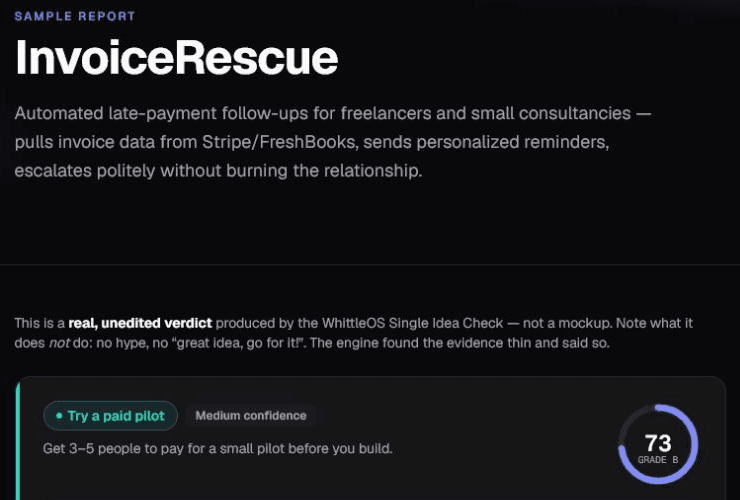
The model ratings behind a result can vary between runs. The arithmetic and published checks are fixed in code, but that does not make the market judgment repeatable or accurate. Read the evidence and challenge it; do not outsource the decision to the number.
The sequence to keep
- Name one buyer and one costly problem. If you cannot write both without words such as “everyone,” the market is still too broad.
- Ask for a costly action. Prefer payment when the question is price; use a smaller signal only when you are explicit about the smaller question it answers.
- Run the economics. Price becomes customer count, and customer count becomes work.
- Choose and register the structure the operation needs. Use official local sources and professional advice where appropriate.
- Deliver the narrow promise. Learn what repeats before automating it.
- Keep the stop condition. A missed bar is an answer, not an invitation to move the bar.
That is how you start a business without letting the easiest visible tasks hide the only uncertain one: whether a buyer wants the thing enough to act.
Common questions
What is the first step to start a business?
Name one buyer, one painful job and one costly action that would show the buyer wants the outcome. A paid pilot, pre-order or other real commitment gives you more information than a name, logo or formation filing.
Do I need an LLC before I test a business idea?
Not every low-risk test requires an LLC, and the right structure depends on your location, risk, ownership and tax situation. Keep the first test narrow, then use official state guidance and qualified legal or tax advice for the structure your real operation needs.
When should I build the product?
Build after the cheapest test has produced a signal that needs a product to answer the next question. If nobody will make the smaller commitment, more software usually makes the unanswered question more expensive rather than clearer.
Read next
- How to start an LLC: check the idea before you file →
- What is a startup? The point where an idea meets a buyer →
- Side hustle ideas that can turn into a product →
- The startup idea validation checklist, in the order that saves time →
- Will people actually pay? The signals that count before you build →
- Customers-needed calculator →