

The formation threshold
File for an operating reason, not reassurance
Idea still uncertain
Test demand, reach, and pricing before the filing spend
Operation needs an entity
Use the official state route and qualified advice
To start an LLC, use the official filing route for the state where the business will operate: choose the structure, confirm the name and registered-agent requirements, file the state formation document, then handle the tax IDs, licenses, records and accounts your situation requires. But do not let filing answer the wrong question. An LLC can organize a business; it cannot prove a buyer wants it.
This is a product-validation guide, not legal or tax advice. LLC rules, filings and consequences vary by state and circumstance. Verify your path with official agencies and a qualified adviser where the decision matters.
First decide what the LLC is for
An LLC is a legal structure, not a validation badge. The right structure depends on ownership, location, liability, taxes and the work the business actually performs. Those are real reasons to form an entity. “I need to feel committed to the idea” is not one.
As of 2026-09-26, the U.S. Small Business Administration's structure guide says structure affects liability, taxes, fundraising and paperwork, and that requirements vary by state. It also describes a sole proprietorship as one possible way to test a low-risk idea before a more formal structure. That is not a recommendation for your case; it is the reason a universal “form the LLC first” rule would be false.
Ask what the business is about to do. Taking on partners, signing contracts, hiring, carrying meaningful liability or separating a real operation can make structure urgent. A landing page that asks whether anybody wants a low-risk software concept may not create the same need. Your state's rules and your adviser decide where the line sits.
Run the market questions before the filing questions
Four questions from the existing idea gate belong before formation because paperwork cannot answer them:
A selected pre-filing subset of the published 12-question single-idea gate. These checks cover market and operating risk; they do not replace legal formation advice.
“Can it make money?” means a named buyer and exchange. “Can it charge enough?” turns a plausible problem into operating arithmetic. “Can you reach buyers?” asks for a channel you can actually use. The compliance question is the signal to stop guessing and get qualified advice — not permission to dismiss the risk yourself.
If the first three are blank, filing produces a cleaner container for the same uncertainty. Run a narrow paid test, or at least the strongest costly action the situation safely allows, before spending on a company shape the idea may never need.
Follow the official formation path
Once an LLC fits the real operation, the federal overview is a map to the state process, not a substitute for it. The SBA launch guide says registration depends on structure and location, directs LLCs to state agencies, and notes that state rules determine the documents and fees. It also points to registered-agent, operating-agreement, local permit and foreign-qualification questions.
Use this order as a checklist of places to verify, not as state-specific instructions:
- Choose the state and confirm the structure. Start with the official state business portal. If ownership, liability or tax treatment is unclear, settle it with qualified advice.
- Check the entity name and registered-agent rules. State naming rules and availability are separate from owning a domain or filing a federal trademark.
- File the state's formation document. The name and contents vary, so copy the requirements from the state rather than a generic template.
- Write the operating rules. Ownership, authority, distributions and exits deserve a written answer even when the state does not put every answer on the formation form.
- Handle tax IDs, licenses and accounts. The IRS EIN page says to form the legal entity with the state before applying for an EIN and provides the federal application directly. State and local tax or licensing steps remain separate.
- Maintain what you created. Reports, taxes, renewals and records do not disappear after the acceptance notice.
There is deliberately no fee table here. A national number goes stale and hides the state-specific costs that matter. Read the current official state page on the day you file.
Check whether the price can carry the business
Before formation spend becomes sunk cost, turn the intended monthly price into a customer count. This illustration uses a $3,000 monthly target. The price rungs are planning inputs, not a claim about your market.
| Monthly price | Customers needed for the target | Question before filing |
|---|---|---|
| $19 | 158 | Can you repeatedly reach and serve this many buyers? |
| $49 | 62 | Can you repeatedly reach and serve this many buyers? |
| $99 | 31 | Can you repeatedly reach and serve this many buyers? |
Customer counts are computed by the function behind the customers-needed tool. Formation cost is absent on purpose: the figure tests the business model, not a state fee.
If the answer is no at every plausible price, the next task is not an LLC. It is changing the buyer, the outcome or the delivery model.
What an idea check adds — and what it does not
The product can put the idea through the full 12-question gate, score the areas that survive and return a next action. The screenshot below is a real sample verdict that asks for a paid pilot before a wider build.
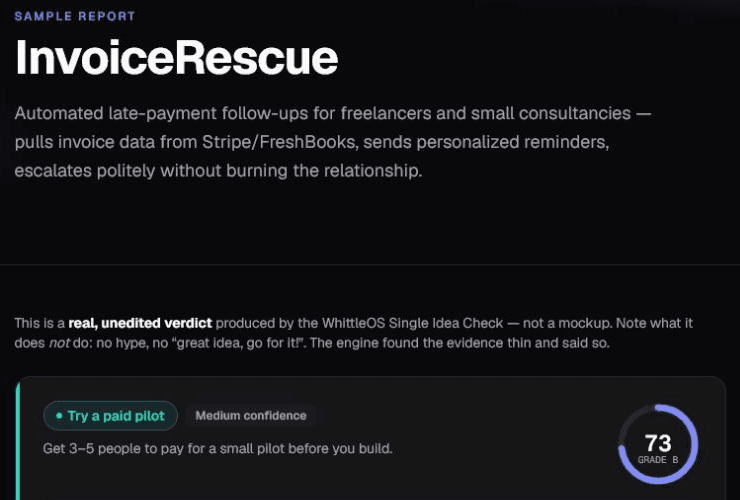
That boundary is important. Use the free Whittle Score or a full idea check for market and founder-fit questions. Use official state and federal sources — and professional advice where needed — for the entity.
File when the operation needs a company, not when the idea needs reassurance
The clean order is: test the buyer, make the economics plausible, choose the structure, file through the official route, then keep the records and obligations the entity creates. Sometimes risk or a contract moves formation earlier. That is a legal and operating reason, not evidence of demand.
An LLC can protect and organize the business you are actually running. It cannot turn an untested idea into one.
Common questions
Can I test a business idea before forming an LLC?
A narrow, low-risk demand test may be possible before formal formation, but the right structure and timing depend on your location, activity, ownership and liability. Use official state guidance and qualified advice for your situation.
Where do I file an LLC?
LLCs are formed under state law. Start with the official business-registration page for the state where the business will operate, not a paid filing service or a generic fee table.
Does forming an LLC validate a business idea?
No. Formation can create the legal entity your operation needs; it does not show that a buyer has the problem, that you can reach them or that they will pay your intended price.
Read next
- How to start a business: test the buyer before the paperwork →
- The startup idea validation checklist, in the order that saves time →
- Will people actually pay? The signals that count before you build →
- How many customers you need, and whether you can carry them →
- Whittle Score calculator →
- What a startup idea check involves →