

From hours to an asset
Keep the paid evidence and remove repeated labor
Sell the work
Meet a buyer and learn the real job
Find repetition
Separate mechanics from judgement
Test the slice
Ask a second buyer to pay
Productize
Build only what repeats
The best side hustle ideas start with paid work and end by removing your hour from the next sale. Freelancing, local services and coaching can produce cash quickly, but they remain second jobs while each customer repeats the same labor. Look for the recurring input, decision or deliverable that can be standardized, test whether another buyer will pay for that narrower outcome, then productize only the part that truly repeats.
A side hustle is not automatically an asset
There is nothing wrong with selling hours. A service is often the fastest way to meet buyers, learn their language and get paid. The mistake is calling it leverage before the delivery has changed.
Use one test: if sales doubled next month, would your delivery hours roughly double too? If yes, you have useful work and a capacity ceiling. A product begins where the same underlying asset, workflow or software can serve the next buyer without repeating the whole job.
That does not make the income passive. Products need distribution, maintenance, support and replacement for customers who leave. It changes which work repeats and whether revenue can grow without consuming the same amount of founder time.
Start where a buyer already spends.
Separate the stable mechanics.
Ask another buyer to act.
Build only the repeatable slice.
The route preserves the service as evidence instead of treating it as a business model you must escape immediately. Productization starts only after a second buyer wants the repeated slice.
Side hustle ideas by the skill you already have
Start from what someone will already pay you for. Each row is a side hustle you can sell as a service this month, and the narrower slice that might later sell without another copy of your hour. None of it is a demand claim — the second column is the hypothesis you would test.
If you write or edit
| Side hustle | What could become a product |
|---|---|
| Landing-page copy for small SaaS founders | A fixed-price teardown with a reusable review checklist |
| Newsletter editing for creators | A style guide and pre-send checklist sold per niche |
| Grant or proposal writing for nonprofits | Proposal templates and a deadline tracker for one funder type |
If you design
| Side hustle | What could become a product |
|---|---|
| Brand kits for local businesses | Industry-specific kits a buyer customizes without you |
| Pitch deck design for founders | Deck templates plus a structure checklist |
| Social graphics for small retailers | A monthly template pack tied to one retail calendar |
If you build software
| Side hustle | What could become a product |
|---|---|
| Website fixes for small businesses | A maintenance and uptime plan with a fixed monthly scope |
| Shopify store setup | A small app for the one setup task every store asks for |
| Automations for small teams (Zapier/Make) | Packaged automation recipes for one tool pair |
If you work with numbers
| Side hustle | What could become a product |
|---|---|
| Bookkeeping cleanup for freelancers | A reconciliation checklist or tool for one invoicing app |
| Monthly reporting for small shops | A fixed report for users of one sales platform |
If you teach or coach
| Side hustle | What could become a product |
|---|---|
| Online tutoring | Session recaps and homework tracking for independent tutors |
| Fitness coaching | Session-package and no-show tracking for solo trainers |
If you serve people locally
| Side hustle | What could become a product |
|---|---|
| Pet sitting or dog walking | Intake and waiver forms, or scheduling, for solo pet-care providers |
| Event or wedding photography | A proposal-and-contract flow, or client galleries, for solo shooters |
| Handyman or cleaning work | A quote template and booking link that removes back-and-forth |
The tutoring, fitness, pet-care and wedding rows are not guesses. Our own screening runs shortlisted a software version of each — you can read them, with the tests that would kill them, in business ideas that survived a filter. Shortlisted is still not sold.
Five routes worth testing
These are routes, not recommendations. None carries a demand claim until you find the buyer and ask for costly action.
Freelance delivery to a workflow product
Track the requests clients repeat: collecting assets, reconciling a report, formatting a handoff, chasing an approval. The product hypothesis is the stable workflow around your expertise, not the bespoke judgment clients hired you for. Sell the workflow to another similar client before writing software for it.
Local service to a coordination tool
Scheduling, quoting, reminders and status updates repeat across many local services. The operator's craft does not become software; the coordination around it might. A good test is a manually delivered concierge version that asks a business owner to pay for fewer missed handoffs.
Coaching or teaching to a reusable diagnostic
The relationship, accountability and judgment may remain the service. Intake, progress records, homework delivery and recurring assessments are more product-shaped. Keep the human outcome out of the promise unless the product can actually deliver it.
Research work to a reference subscription
If buyers repeatedly pay you to collect, clean or monitor the same kind of information, the refreshing dataset or alert can become the product. The hard question is not whether you can publish it once; it is whether the update remains valuable enough to renew.
Manual reporting to a small software product
Spreadsheets and recurring reports reveal stable inputs and outputs. Automate only after you can name which columns stay stable across buyers and which exceptions still require you. A “dashboard” that needs custom interpretation every month is a productized service with a chart.
If the buyer keeps accessing an operated software service, the result is the recurring exchange described in what SaaS means. That shape brings an ongoing support and reliability obligation with it; the subscription is not the shortcut around the work.
If none of these matches your skills or your available week, use the founder read before choosing from a list. Fit is part of the idea, not a preference to add later.
Stress-test the side-hustle shape against the week
The model below uses a $3,000 monthly target and a 8-hour weekly budget from the neighboring guide on validating while working full time. Each row has an authored price and support-time assumption. They are not market averages. Customer counts and weekly hours are calculated by the public tools.
| Modeled shape | Price | Customers | Support / week | Week consumed |
|---|---|---|---|---|
| Freelance retainer | $500 | 6 | 4.1 h | 51% |
| Productized service | $199 | 16 | 3.7 h | 46% |
| Small software product | $49 | 62 | 2.4 h | 30% |
| Reference subscription | $19 | 158 | 1.2 h | 15% |
A stress test, not a benchmark. The inputs are visible so you can replace them; the outputs call the customers-needed and support-load functions. Support below 2 hours is light, through 8 is moderate, and past that is heavy on the shared solo-founder scale.
The table refuses a comforting shortcut. High-ticket service needs few customers but can still eat the week because each account consumes hours. Low-ticket software needs many customers, so small per-account minutes still multiply. A product-shaped side hustle has to close both equations.
Validate it inside the time you actually have
Use one 2-week sprint and one question. Do not split the week between several ideas.
- Write the buyer and promise. One person should recognize themselves and the outcome.
- Show the price. If you hide it, the test cannot reach pricing power.
- Build only the proof. A page, mock workflow or manual delivery is enough when it lets the buyer take the intended action.
- Spend most effort on reach. A perfect page shown to nobody returns silence, not a verdict.
- Freeze the stop condition. Choose the action, count and deadline before traffic arrives.
The expected result is often “not this version.” That is cheaper than turning every evening into a build and learning the same thing after launch.
What idea discovery looks like in the product
If you do not have a paid workflow to mine, Discovery starts from public problems, forms candidates and removes most of them before a shortlist. The screenshot is from the published real-estate run.
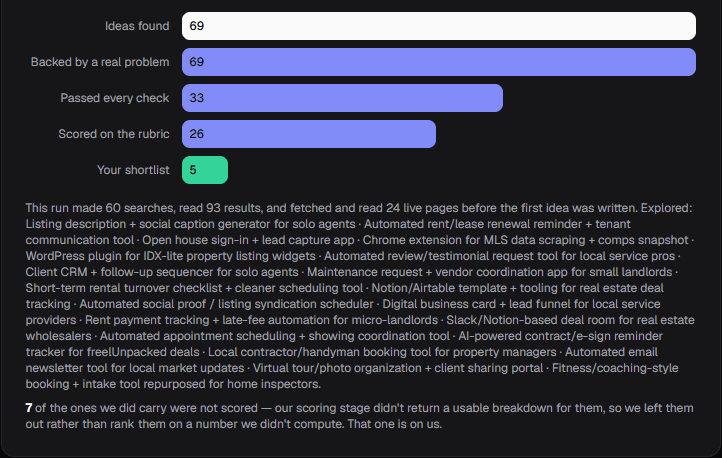
The run is not a promise that a side hustle will work. Its ratings can change between runs, and a shortlisted idea has not sold. It is a way to start with evidence and explicit reasons to stop rather than with a generic list.
Choose the route, then earn the product
Start with the route closest to a buyer you can reach. Sell the narrow outcome manually. Watch which mechanics repeat. Ask a second buyer to pay for that same repeatable slice. Only then decide whether the right product is software, data, a template, a paid workflow or a deliberately productized service.
The side hustle does not become an asset because you call it a business. It becomes one when the next sale depends more on the reusable system and less on another copy of your hour.
Common questions
What is a good side hustle to turn into a business?
Start with work somebody already pays you to do, then look for the repeated input, decision or deliverable that stays the same across buyers. That repeated piece is a product hypothesis; the bespoke judgment around it may remain a service.
How is a side business different from a second job?
A second job pays for another unit of your time. A side business can keep selling or serving customers through a reusable process, asset or product, although it still requires acquisition, maintenance and support.
How do I test a side hustle idea while working full time?
Choose one buyer and one promise, put a real action on a small page and spend more of the limited week reaching buyers than polishing the page. Write the pass and stop conditions before results arrive.
Read next
- How to start a business: test the buyer before the paperwork →
- Validating an idea on six to ten hours a week →
- Low-cost startup ideas for solo developers, ranked by time to evidence →
- Micro SaaS ideas: the arithmetic that decides them →
- Will people actually pay? The signals that count before you build →