

From idea to repeatability
A startup is the search, not the costume
Documented problem
Attach the idea to a buyer's words
Costly action
Let the buyer challenge the promise
Delivery
Learn what the outcome actually costs
Repeat
Reach the next buyer the same way
A startup is an organized search for a repeatable business while the important assumptions are still unsettled. It is more than an idea because real buyers can now act on a specific promise, and it is not yet an ordinary business because demand, channel, price and delivery may still fail. A payment is the first signal that reaches the price question; it is not proof the search is over.
A working definition, not a badge
“Startup” often gets used for any new company, any technology product or any ambitious founder. None of those meanings helps you decide what to do next.
Use the word operationally: a startup is a temporary search for a repeatable way to create, deliver and capture value. The search has a buyer, a promise and tests that can still change or end the idea. Once the model is known and the work is mainly execution, you are operating the business rather than searching for it.
This definition does not require venture capital, employees or software. It does require uncertainty you are testing. A local business opening a proven model can be new without being a startup in this sense. A solo founder testing an unfamiliar subscription can be a startup without looking like a funded company.
The idea becomes real when somebody outside it pays a cost
Founders can spend months making an idea look like a company from the inside. Buyers supply the outside evidence.
The validation grader behind our published signal ladder recognizes 5 rungs. The strongest is a payment or a pre-order, because it is the one that reaches the price question:
Costs the buyer money
The cells are derived from the shipped validation-outcome grader, not from a marketing ladder. Payment can bear on pain, reach and price; it still cannot prove retention or support load.
A compliment, visit, signup or reply can be useful. Each answers a smaller question. Calling the idea a startup does not promote those signals into payment, and calling the company incorporated does not promote payment into repeatability.
Most candidates stop before the startup story gets interesting
The retained Discovery census shows why the search needs a gate. Across 33 real, non-synthetic runs measured on 2026-09-22, 1,728 candidates entered and 895 were stopped at the deal-breaker gate. That is 51.8%.
This is a record of our machine's behavior, not an accuracy claim and not a market-wide failure rate. The ratings can vary between runs. The valuable part is that every counted stop names a reason.
An arithmetic remainder, not proof of advancement
Counted reasoned drops and the four most-cited reasons. The second tile is the arithmetic remainder: it can include candidates with no gate entry, so it does not mean they reached deeper scoring.
The most common reason was that the run found no documented problem behind the candidate. That is an evidence failure, not proof of absence. It still marks the difference between an idea that sounds plausible and a startup search that has attached itself to a real buyer problem.
Startup versus small business
| Question | Startup search | Established small business |
|---|---|---|
| Is the buyer known? | A hypothesis still being narrowed | Usually part of the operating model |
| Is the channel repeatable? | Under test | Expected to produce customers |
| Is the price settled? | A claim buyers must challenge | Part of normal selling |
| Is delivery stable? | May still change sharply | Mostly an execution problem |
| What is the next job? | Remove uncertainty | Operate and improve the model |
The columns describe stages, not better and worse companies. A stable local service can be an excellent business without needing startup uncertainty. A funded technology company can remain a startup for years if it has not found a repeatable model.
What the first payment changes
Payment changes the status of one claim: a real person accepted the promise, price and channel at least once. That is why it is the cleanest boundary between “an idea we like” and “a search with external evidence.”
It does not prove the model repeats. The buyer may be unusually close to you. Delivery may require more work than the price can support. The customer may leave. The platform may change its rules. The second payment, renewal and support record answer different questions.
So the practical sequence is:
- Find a documented problem. Preserve what the buyer said and where they said it.
- Write one narrow promise. Name the buyer and the outcome without hiding behind a category.
- Ask for the strongest safe action. If price is the question, ask for money.
- Deliver manually enough to learn. Watch which work repeats before automating it.
- Test repetition. Reach the next buyer through the same channel and deliver without inventing a new service each time.
A verdict is a next action, not a certificate
The real sample report below illustrates the posture. It does not declare a business proven. It shows a scored result and asks for a paid pilot before a broader build.
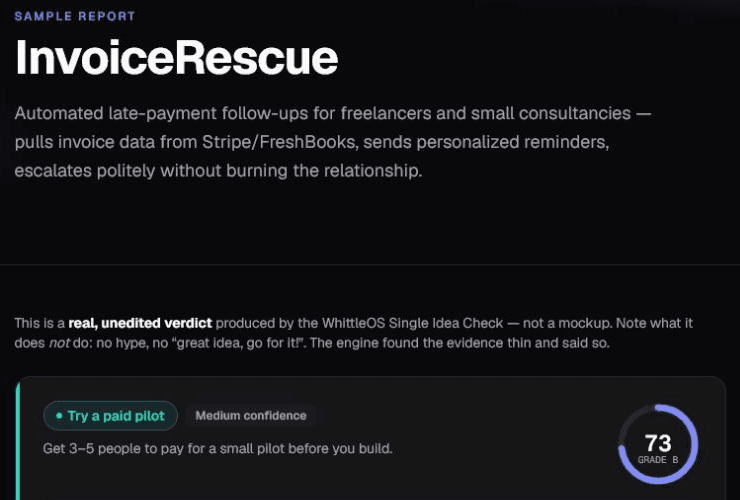
If you already have the idea, check it against the gate and read the evidence behind the result. If you do not, start from documented problems and let elimination produce the candidate.
A startup is not the paperwork around an idea. It is the disciplined search that lets buyers end, change or confirm the idea before the founder mistakes activity for a business.
Common questions
What is a startup in simple terms?
A startup is an organized search for a repeatable business before the important assumptions are settled. It has a specific buyer, a promise and tests that can still end or change the idea.
Is every new small business a startup?
Not in the useful operational sense. A conventional small business can begin with a known model and focus on execution; a startup is still searching for whether its model, channel and price repeat.
When does an idea become more than an idea?
When somebody outside the team accepts a real cost for the promised outcome. A payment reaches the price question; an email, reply or compliment can answer smaller questions but cannot substitute for it.
Read next
- How to start a business: test the buyer before the paperwork →
- Where startup ideas actually come from →
- Why startup ideas fail: 36 rejections, itemised →
- Will people actually pay? The signals that count before you build →
- The startup idea validation checklist, in the order that saves time →
- A complete Discovery run →