

The recurring exchange
Recurring revenue carries a recurring obligation
Recurring job
The buyer needs the outcome again
Operated software
Access continues over time
Recurring payment
Billing follows the service
Recurring duty
Support and reliability remain
SaaS means software as a service: the customer keeps accessing software that the provider keeps operating. The continuing service is the definition. A subscription is common because value keeps arriving, but recurring billing also creates recurring obligations — hosting, maintenance, support and a reason for the customer to stay. A downloadable app sold once is software; software you keep responsible for delivering is SaaS.
The simple definition has two sides
The customer sees access. The operator sees an obligation. Leave either side out and the definition becomes a pricing slogan.
The buyer returns because the software continues to perform a useful job.
The provider hosts, updates or otherwise keeps the service available.
Reliability, support and customer trust do not end after checkout.
The recurring payment is only stable when these three things recur together. Billing can repeat without value for a while; it cannot make that relationship durable.
This is why “put it on a monthly plan” is not a SaaS strategy. If the underlying job happens once, the subscription is fighting the problem. The guide on one-time work versus subscriptions starts with the job's recurrence and lets billing follow it.
A real one-person SaaS candidate
The public Discovery fixture makes the definition concrete. Its highest-scoring finalist is SoloPipe: a dead-simple deal pipeline tracker for solo real estate agents, stripped of broker/team overhead. The buyer is solo real estate agent tracking active deals/pipeline.
That is SaaS-shaped because the buyer's pipeline changes continually. Access has to continue, data has to remain available, and the provider inherits the questions and failures around that workflow. None of this says the idea sold. The run returned Test it first at a score of 52, and its next move was not “build it.” It was:
Ship a narrow landing page targeting the single-user pipeline wedge and test organic community response before writing code.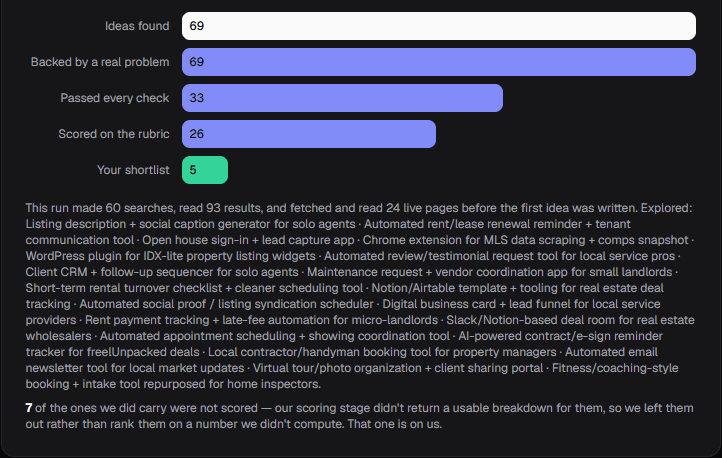
That distinction matters. A plausible recurring workflow is a SaaS candidate. It becomes evidence of a business only when a buyer acts and the operator can carry the resulting service.
What the subscription implies for one person
Put a transparent model around the candidate. Suppose the target is $3,000 in monthly recurring revenue and each customer needs 10 support-minutes per month. The price rungs below are illustrative assumptions — the fixture does not claim these prices or support times.
| Monthly price | Customers required | Support / week | Solo band |
|---|---|---|---|
| $19 | 158 | 6.1 h | moderate |
| $39 | 77 | 3 h | moderate |
| $79 | 38 | 1.5 h | light |
A stress test from the public calculator functions. Lower price requires more accounts; with the same per-account support assumption, more accounts also create more weekly work.
At the modeled middle price, $39 requires 77 customers and creates 3 support hours a week. The calculator calls that moderate. Its light band ends below 2 hours; the moderate band runs through 8. Those boundaries come from the same constant as the support tool, not from this article.
The useful lesson is not the assumed price. It is the chain: price → customer count → operating load. Recurring revenue without that second calculation is only half a SaaS model.
SaaS versus nearby business shapes
| Shape | What the buyer receives | What keeps recurring |
|---|---|---|
| One-time software license | A usable software copy or fixed version | Nothing has to recur |
| SaaS | Continued access to an operated software service | Value, delivery and responsibility |
| Productized service | A standardized outcome with human delivery | The engagement or retainer |
| Marketplace | Access to an exchange between participants | Supply, demand and transaction trust |
A business can combine these. A SaaS product may include onboarding services; a marketplace may charge a subscription. The question is what the customer is really buying and what work repeats for the operator. If the founder must make a new judgment for every customer, the recurring invoice may be attached to a service business rather than a software product.
What makes SaaS viable for one founder
- The buyer can decide without a committee. Procurement and custom legal review turn a small subscription into an enterprise sale.
- The first value arrives without managed setup. Every manual import or configuration step multiplies with the customer count.
- The price funds the account base. Cheap software may require an audience and support capacity that one founder does not have.
- The problem returns. A recurring bill cannot create recurring pain.
- The channel repeats. A product that can be served repeatedly but found only once is not yet a repeatable business.
The neighboring guide on SaaS ideas starts with those failure modes. The micro-SaaS guide goes deeper on the one-person arithmetic.
What the model still cannot prove
The table cannot prove demand. It cannot tell you the true support minutes. It cannot tell you whether the buyer will remain subscribed after the first useful month. Those require a buyer, a delivered service and time.
That is the honest end of the definition. SaaS is not “software with recurring revenue.” It is an ongoing exchange: the buyer keeps receiving value, and you keep earning the right to charge by carrying the service behind it.
Common questions
What does SaaS stand for?
SaaS stands for software as a service. The customer accesses software that the provider continues to operate, maintain and improve instead of receiving a finished software copy and ending the relationship.
Does SaaS have to be a monthly subscription?
No single billing cadence defines SaaS. Monthly and annual subscriptions are common because the service continues, but the defining feature is the ongoing delivery and operating obligation, not one particular checkout interval.
What makes a SaaS idea workable for one person?
The buyer must be reachable, the price must support a manageable customer count and the support required by those customers must fit the founder's week. A product can be useful and still fail that one-person equation.