

Compare
WhittleOS vs IdeaProof
One scored our own idea 72/100 and PROMISING on 2026-06-10; the other sources real candidates, kills the weak ones, and scores what's left to your founder profile. Here's the honest, dated comparison.
How is WhittleOS different from IdeaProof?
IdeaProof scores an idea you paste into it. WhittleOS is a decision OS: it can source candidate ideas itself, it is deliberately kill-biased, it links the problems it cites to the page each was read on or marks them as its own estimate, and it binds the verdict to your budget, time and sales style.
TL;DR
IdeaProof is a fast, broad pre-launch toolkit: paste an idea, get a polished 100-point score plus a business plan, brand kit, logo, and ad creatives in about two minutes. WhittleOS does the opposite job — it sources real candidates itself, kills the weak ones against documented pain, and ranks what survives against your founder profile, with a deliberate kill-bias and an honest "zero finalists" when a niche is thin. If you want a confidence-building package, IdeaProof. If you want a hard, founder-specific build/validate/kill decision before you burn three months, that's us.
Same category. Different exit.
One path packages the idea you brought. The other is built to end weak ideas before they become projects.
WhittleOS
Starts with
Your founder profile and either a niche or an idea
Does
Sources evidence, applies fixed deal-breaker checks, then has code set the total
Leaves you with
15 / 100 — KILL (confidence HIGH)
IdeaProof
Starts with
One idea or URL
Does
Produces a fast score and a broad pre-launch package
Leaves you with
72 / 100 — "PROMISING" — "Excellent potential! You’re among the top ideas we’ve seen"
The public entry point and the preserved dogfood output
These are not reconstructed competitor screens. The first image is IdeaProof's public validator as observed today. The second replays the preserved WhittleOS output through the real current result component. IdeaProof's historical 72/100 report was preserved as a raw receipt, not as a bitmap, so its exact numbers remain in the dated table below.
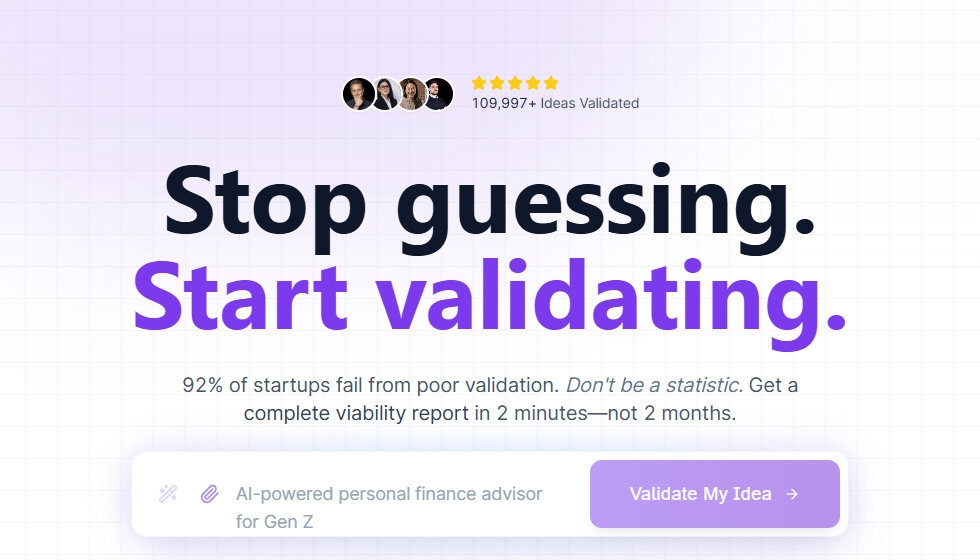
Current public entry point. This is not the historical 72/100 result screen.
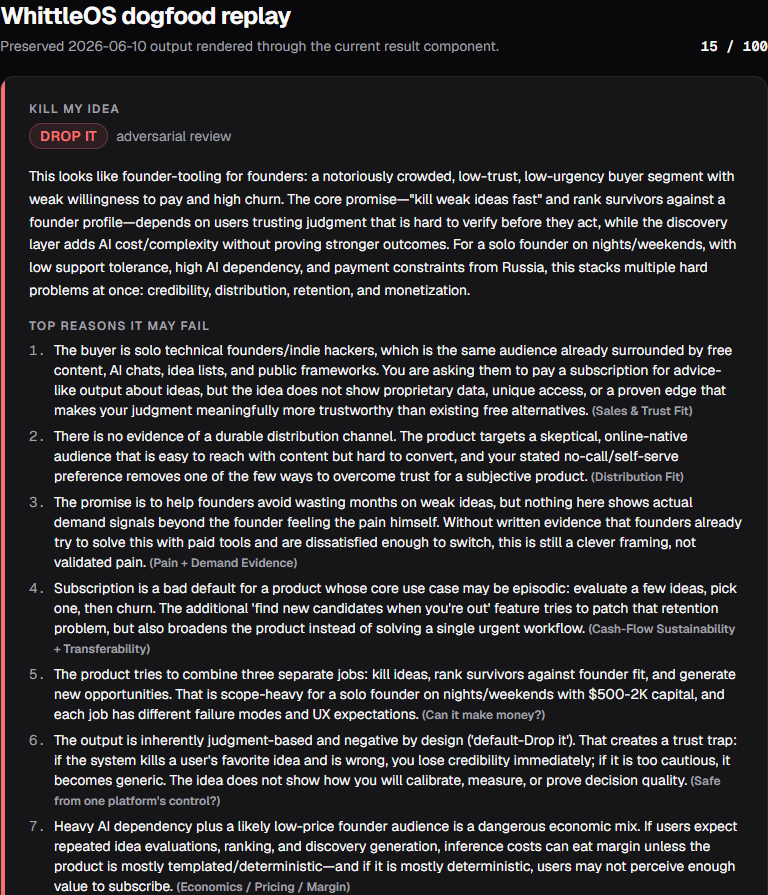
The preserved 2026-06-10 JSON rendered through the current production result component; the historical score and reasoning are unchanged.
At a glance
This table contrasts behavior and deliverable, never a cheaper number — the pricing row names the model shape only.
| WhittleOS | IdeaProof(as of 2026-09-11) | |
|---|---|---|
| Core job | Decision OS: source → kill → rank against your profile | Fast validator → all-in-one pre-launch toolkit |
| Headline behavior | Kill-biased; honestly returns an empty shortlist on weak niches | GO/NO-GO score; scored our own idea 72/100 “PROMISING” (2026-06-10) |
| Sources its own ideas? | Yes — Discovery sweeps live sources for documented problems across ~30 markets and shows the source per candidate | Free idea generator: pick an industry, get five ideas with trend scores (its site, 2026-09-11); the validator itself starts from the idea you paste |
| Who grades the idea? | The Whittle Score: in-code scoring (the model rates areas, code sets the total) | Advertises a weighted score across 11 criteria and describes the calculation (2026-09-11); we have not audited it |
| Evidence | Provenance tiers + clickable source links per pain | Advertises "50+ sources, every claim cited" |
| Bound to the founder? | Yes — scored to your goal, capital, time, channel, support tolerance | Input is the idea alone — "one sentence or a URL" (its site, 2026-09-11); no founder profile is asked for |
| Validation stance | No-call / async by design (landing + real CTA + outreach) | Score, market sizing, projections and a GTM section; the report we received (2026-06-10) had no validation plan or outreach |
| Breadth | Focused: 17 modes, including autonomous Discovery | Broad: validation + plan + brand + logo + ad creatives |
| Speed | 10-40 min per market — it runs in the background and emails you | ~2 minutes per report |
| Pricing model | One-time credit packs (price is a footnote) | One-time credit packs, staged unlock |
| Maturity | Live but early-stage — no logos/testimonials yet | More marketing presence; few independent reviews |
Detailed comparison
What it does
IdeaProof is built for speed and breadth. You paste an idea and ~2 minutes later you have a 100-point viability score, a GO/NO-GO verdict, and — as you spend credits — a market analysis, business plan, brand strategy, AI logo, and platform-specific ad creatives. It's a pre-launch package, and it's genuinely the broadest feature set in the category.
WhittleOS is a decision OS, not a report generator. Point it at a niche — or at nothing at all — and it sources real candidates itself, screens them against documented pain, ranks what's left against your founder profile, and hands you a single recommended next move. Already have an idea? You get a BUILD / VALIDATE / KILL verdict with the reasons, plus focused modes (Kill My Idea, Pricing Power, Support Burden, Platform Risk, Pivot Wedge, No-Call Validation, MVP Scope, and more).
The difference in one line: IdeaProof helps you package an idea you already like. WhittleOS helps you decide — including telling you to walk away, and including finding the idea in the first place.
Honesty & bias
IdeaProof markets itself as a way to kill bad ideas fast. So on 2026-06-10 we gave it ours: it returned 72/100, “PROMISING”, “Excellent potential! You’re among the top ideas we’ve seen” — while our own balanced gate returned KILL and our adversarial mode returned KILL as well. That is one dated run on one idea, and we are not turning it into a claim about their average score. It is the behaviour we are contrasting with: a validator that told us to build this.
WhittleOS is deliberately kill-biased. Most ideas should die early, and the gate is built to find the reason they should. When a swept niche is genuinely weak, it returns zero finalists — and that's the system working, not failing. We'd rather lose your trust by being blunt than keep it by flattering you into a build.
How the Whittle Score is produced
IdeaProof advertises a weighted score across eleven criteria and describes the calculation on its site (as of 2026-09-11); we have not audited how that weighting is applied, so the contrast we can make is about our own side. WhittleOS never lets the model set the total: it rates each area of the rubric, and the overall score is then computed in code from fixed weights, with a hard decision matrix turning the verdicts into KILL / VALIDATE / BUILD. The model supplies the evidence and the per-area ratings; the weighting, the arithmetic and the gate are deterministic. The ratings themselves vary between runs, as any model's do — what does not vary is the standard they are judged against. That's why the verdict is auditable: you can see which check produced it, rather than take a number on faith.
Sourcing ideas
IdeaProof's validator starts from an idea you paste, and its site offers a free idea generator that returns five ideas per industry with trend scores (as of 2026-09-11). WhittleOS sources candidates differently — Discovery sweeps real sources, pulls live evidence, and funnels candidates through the kill-gate to a handful of ranked finalists per niche. In one recorded comprehensive sweep across ~30 verticals it sourced roughly 3,430 candidates and surfaced 93 ranked finalists (graded mostly B/C — with honest zero-finalist verticals where nothing was worth keeping). This is the wedge nobody else in the validator category does: we bring the ideas, then we tell you which to kill.
Evidence & provenance
IdeaProof advertises "50+ authoritative sources" with "every claim cited back to its source." We have not audited that, and we are not going to put a number on it we cannot show you. What we can show is our own side: WhittleOS tags every pain with a provenance tier — grounded in a page we securely fetched, a search snippet, or pasted text — and surfaces clickable source links so you can read the evidence yourself. When we don’t have evidence, we label it not verified instead of inventing it.
Validation approach
IdeaProof's report gives you a GO/NO-GO, market sizing, projections and a go-to-market section; the report we received on 2026-06-10 contained no validation plan and no outreach. WhittleOS is no-call / async by design. When it's time to validate, the plan is a landing page with a real CTA (waitlist / pre-order / paid pilot) plus async outreach — never "go book 20 discovery calls." It fits your stated time budget and gives you explicit signals, success criteria, and the point where you should walk away.
Pricing model
(Model shape only — no price war.) Both tools use one-time credit packs rather than subscriptions — neither locks you into a recurring fee. IdeaProof's model adds a staged upsell: the free validation produces the score, and the deeper sections (market analysis, business plan, brand, visuals, marketing) each unlock by spending more credits. WhittleOS spends credits on the decision work itself — a free founder read to start, then credits per analysis and per sweep. We compete on what the credits buy you (a decision, sourced candidates, evidence), not on being the cheaper number.
The receipts
The strongest thing we can show you isn't a stat — it's what happened when we ran our own product through both tools. On 2026-06-10 we fed the same WhittleOS one-liner to IdeaProof and to our own modes:
Swipe the table sideways for the full comparison →
| Tool | Verdict | Score |
|---|---|---|
| IdeaProof | "PROMISING" — "Excellent potential! You’re among the top ideas we’ve seen" | 72 / 100 |
| WhittleOS — Kill My Idea (adversarial) | KILL (confidence HIGH) | 15 / 100 |
| WhittleOS — Single Idea Check (balanced) | KILL (short-circuited) | 0 / 100 |
The idea both tools were grading was WhittleOS itself. Our balanced gate killed it on a single filter — KF-07, the AI-dependency check: "take the LLM out, what's left?" — with 11 of 12 filters passing. Our adversarial mode returned ten grounded failure reasons (crowded, low-trust founder-tooling segment; episodic usage that fights a subscription; unproven trust and calibration; real payment friction) and a salvage wedge we're actually weighing. The whole run was gpt-5.4, three modes, about 73 seconds, $0.09 of inference.
What this proves, honestly
A validator that can't kill its own maker's idea can't be trusted to kill yours. Ours did. That's the behavior we're selling.
What this is NOT
This is one run of our own idea on one date — not a general accuracy benchmark, not a multi-idea head-to-head. IdeaProof's 72 is a single observed report, not its guaranteed output, and we gave our own modes a founder profile IdeaProof never asks for (binding the verdict to the founder is our product, but it means the inputs weren't identical). All verdicts are LLM outputs and carry model noise. We publish the run so you can reproduce it (RUN_DOGFOOD=1) and judge for yourself — that's the point.
Who IdeaProof is genuinely better for
We'd rather you pick the right tool than the wrong one. IdeaProof is the better choice if:
- You want speed and a polished package over a hard decision — a score plus a business plan, brand kit, logo, and ad creatives in one ~2-minute pass.
- You're non-technical or a first-timer and want a confidence-building, investor-style artifact to think with or attach to a plan.
- You need brand and marketing assets (logo, visual identity, ad creatives) generated alongside validation — that's real breadth we don't offer.
- You want multi-language reports or an industry-specific validator across many industries.
WhittleOS doesn't generate logos or ad creatives, and we're earlier — no logo wall, no testimonials yet. If breadth and polish are what you're buying, IdeaProof delivers it.
FAQ
- Is WhittleOS just a cheaper IdeaProof?
- No — and we don't compete on price. They're different jobs. IdeaProof packages an idea you bring; WhittleOS sources candidates, runs a kill-biased build/validate/kill decision against your founder profile, and shows you the evidence. The price is a footnote on both sides.
- Why does WhittleOS kill so many ideas?
- Because most ideas should die early, and a validator that rarely says no isn't protecting you. Our gate is deliberately kill-biased and computes the score in code from a fixed weighted rubric — the model rates each area, but the weighting, the total and the gate are code, never the model's own number. When a market is genuinely weak, we hand back nothing rather than manufacture a promising idea.
- Did you really run your own idea through both tools?
- Yes. On 2026-06-10, IdeaProof scored the WhittleOS idea 72/100 PROMISING; our own balanced gate returned KILL (0/100) and our adversarial mode returned KILL (15/100). It's one dated run of our own product — a demonstration of default-KILL versus flattery, not an accuracy benchmark, and re-running it today would not return identical numbers. The verdicts and the reasons are reproduced on this page.
- Does IdeaProof source ideas for me like WhittleOS does?
- Not the way Discovery does. IdeaProof's validator starts from an idea you paste; its site also offers a free idea generator that returns five ideas per industry with trend scores (as of 2026-09-11). Discovery instead sweeps live sources for documented problems, drops the candidates it cannot tie to one, and shows the source next to each survivor.
- What is IdeaProof genuinely good at?
- Speed and breadth. It produces a polished, professional-looking report fast, and it bundles a business plan, brand strategy, AI logo, and platform-specific ad creatives that we don't generate. For a confidence-building pre-launch package, it's a strong pick.
- Will WhittleOS make me get on customer calls?
- No. WhittleOS is no-call / async by design. When it's time to validate, the plan is a landing page with a real CTA plus async outreach that fits your time budget — never book 20 discovery calls.
Bring yourself — we'll bring the candidates.
Get a free founder read and see what a kill-biased read looks like. 2 free credits on signup, no card required.