

Compare
WhittleOS vs ChatGPT
You have already asked a chat about your idea, and it was useful. Here is what it did, what it did not, and the four things a prompt cannot buy — with the search modes conceded first.
How is WhittleOS different from asking ChatGPT?
A chat argues about the idea you type, and with search on it can cite pages. WhittleOS is a decision OS: it goes and finds candidates across a market, drops the ones it cannot tie to a documented problem, labels every problem it could not verify, computes the score in code rather than asking the model for a number, and keeps the decision so later runs can check it.
TL;DR
For a second opinion on one idea you already have, a chat is fine — free, immediate, and with search on it will cite pages too. The difference is what happens when you do not have the idea yet, and what happens after the answer. WhittleOS goes and finds candidates across a market, drops the ones it cannot tie to a documented problem and says which check dropped them, labels every problem it could not verify instead of writing it as prose, has code rather than the model set the total, and keeps the decision so later runs and real outcomes can check it. You are paying for the looking, the throwing away and the record — not for the writing.
Same category. Different exit.
A chat ends in an answer you interpret. WhittleOS ends in a saved decision that later work can check against.
WhittleOS
Starts with
A market, an idea, or no idea at all
Does
Searches, labels evidence, applies a fixed gate, and computes the total in code
Leaves you with
A saved verdict, a shortlist, and the record of what was dropped
A chat
Starts with
The idea and context you type
Does
Answers, argues, searches, and drafts in an open-ended conversation
Leaves you with
A response or research document that you interpret
An open-ended chat and a bounded verdict
OpenAI's own product image shows the conversational surface. The WhittleOS image is a real public sample report. The visual contrast is workflow shape, not a claim that chat cannot search or cite sources.
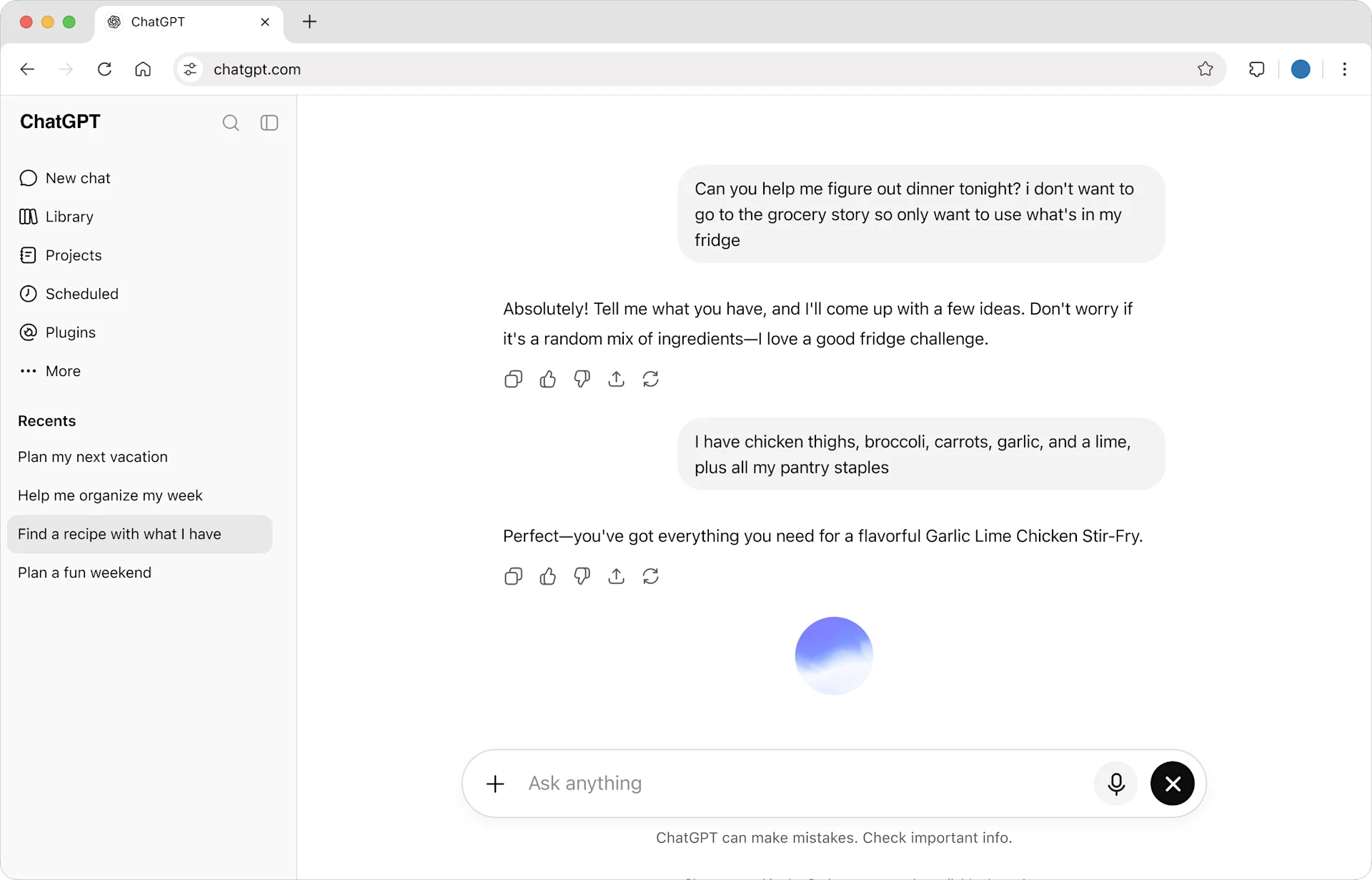
Published by OpenAI on the official ChatGPT overview page.
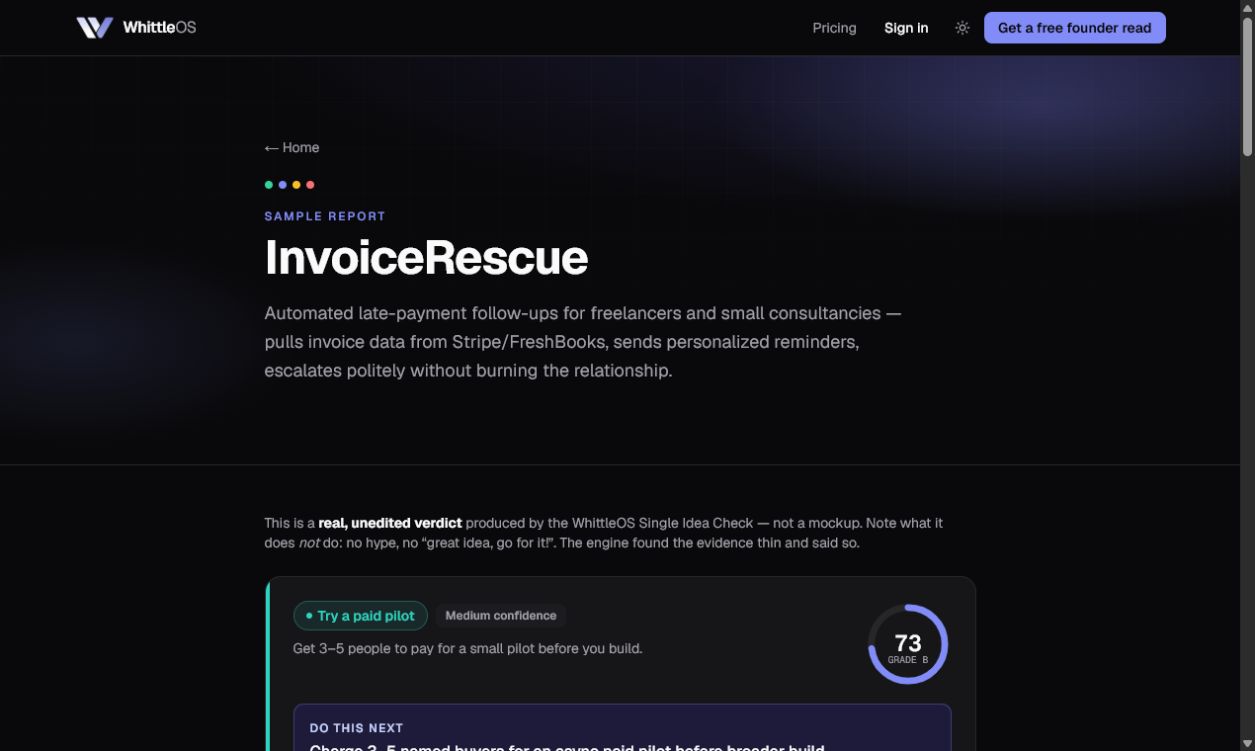
A real report capture used in the launch gallery: a bounded verdict rather than an open-ended answer.
At a glance
Every row is a difference in what each one can DO. "Be more critical" is a prompt anyone copies, so posture is not a row.
| WhittleOS | A chat (ChatGPT, Claude)(as of 2026-09-11) | |
|---|---|---|
| Core job | Decision OS: source → kill → rank against your profile | General assistant: it answers, argues and drafts about anything you type |
| Starts from | A market — or nothing at all. Discovery goes and finds the candidates | The idea you type. With search on it can look things up about that idea; it does not go looking for ideas |
| Where the facts come from | Live searches and pages read at run time; on the published run 32 of 56 problems carry a link you can open | A plain chat answers from memory with a cut-off date. ChatGPT search and Deep Research fetch live pages and cite them (2026-09-11) |
| A claim it could not back | Labelled "not verified" and scored accordingly | Written as prose beside the backed ones. No mode attaches a per-claim verified / not-verified label that the score then depends on (2026-09-11) |
| The checklist | 12 deal-breaker checks and 7 weighted areas, fixed in code between runs | Whatever this session's prompt asks for. A stricter prompt is real — and copyable in five minutes |
| Who sets the number | The Whittle Score: the model rates each area, code sets the total and the grade | The model writes the number it finds plausible, in the same breath as the reasoning |
| Willing to say no | Kill-biased; an empty shortlist when a market is thin | Will argue for killing if you ask it to — as prose, with no gate that has to be cleared |
| Bound to the founder | Yes — your time, capital, skills and sales style are inputs to the checks and the score | Only as context you give it (or it remembers) — not as an input to a check that has to pass |
| After the answer | A saved decision, a shortlist, and the list of what was dropped and why — later runs and real outcomes check against it | A transcript, and whatever memory keeps — not a decision a later run is checked against |
| Speed | An idea check in under a minute; Discovery 10-40 min per market, in the background | Seconds for a chat; a Deep Research report takes up to half an hour |
| Cost | Prepaid credits per run; a free founder read to start | Free, or a subscription. The price is not where the two differ |
Detailed comparison
What a chat is actually good at
Start with the honest half, because a page that pretends otherwise is not worth reading. If you have an idea and want it stress-tested — the obvious objections, the segments you have not considered, a first cut at who might pay — a general-purpose model does that well, immediately, and for free. Anyone selling you a subscription to do only that is selling you a wrapper, and we would rather you spend that free hour before paying us anything: an idea that dies to a chat did not need a paid run.
Three modes, and where each one stops
There are three different things people mean by "asking ChatGPT". A plain chat answers from what it already knows: a compressed memory of the public internet with a cut-off date. Ask it whether people are complaining about a specific workflow this quarter and it produces something plausible in the right shape — and the shape is the problem, because a fabricated complaint and a real one read identically.
Search mode fixes the first half. As of 2026-09-11, ChatGPT with search on and Claude with web search fetch live pages and show links, so "it cannot cite anything you can open" is not true of them and this page will not say it. Deep Research goes further — a multi-step, cited report that takes up to half an hour — and for desk research it is genuinely good.
What none of the three does is the part that makes a decision safe to act on. None runs the idea through a checklist whose weights stay put between sessions. None attaches a verified / not-verified label to each problem it relies on and lets that label move the score. None drops a candidate for failing a gate and tells you it did. And none keeps a record that a later run, or a real outcome, can be checked against. Those are properties of a pipeline, not of a conversation.
The longer answer, mode by mode, has its own page: Can ChatGPT validate my startup idea?
The four things a prompt cannot buy
A gate. An idea you bring passes 12 deal-breaker checks, and a hard failure on any one of them ends it — the run tells you which. A Discovery run considers up to 150 candidates and keeps at most 5; when a market is thin it keeps none, and that is the system working. A chat will argue for killing your idea if you ask it to, as prose. It has no list it must return empty.
A label. Every problem a run keeps says where it came from — a page we opened and read, a search result we saw but could not open, or text you pasted — and when we could not find a source it is marked "not verified" rather than smoothed into a confident sentence. On the run we publish, 32 of 56 problems carry a link you can open, and the page says which ones do not. A research mode cites what it found; it does not tell you which of its claims it could not find anything for.
A total set by code. The Whittle Score is the 0–100 every idea receives: a language model rates 7 areas of the idea, each rating is multiplied by a fixed weight and added up in code, and the total is banded into a letter grade from A to D. The model supplies the ratings and the evidence behind them; it never sets the total. A chat writes the number it finds plausible in the same breath as the reasoning, which is how a weak idea gets a 72. The weights are public: the Whittle Score calculator runs the same arithmetic on ratings you choose.
A kept decision. A run ends in a verdict, a shortlist and the list of what was dropped and why, saved against your account — and if you later mark what actually happened, the record can only be moved down, never up. A chat ends in a transcript — and whatever its memory keeps is context for the next answer, not a decision the next answer is checked against.
Finding the idea in the first place
This is the case a chat serves worst, because it can only reason about what you type. Discovery starts from a market — or from nothing at all — plans it into sub-markets, runs live searches, reads the pages it is allowed to read, and funnels what it finds through the gate to a few ranked finalists per market, each with the problem it rests on and the source that problem came from. Ask a chat for "ten startup ideas in real estate" and you get ten plausible sentences; ask it whether anyone actually has the problem behind idea six and you are back to checking its claims yourself.
Where the model still does the work
WhittleOS uses a language model too, for what models are good at: reading the pages a run fetched, pulling out the documented problems, and rating each area of the rubric with its reasoning attached. Those ratings sample fresh every run and can move an idea a few points — exactly as a chat's answer moves. What does not move is the standard they are judged against: the checklist, the weights, the threshold and the decision matrix are code. The honest framing of the whole product is narrow: a rigorous, kill-biased second opinion that shows its work. Not an oracle. We have also run the gate on 8 ideas whose endings are already known and published every miss — the benchmark, with no accuracy figure attached.
When a chat is genuinely the better tool
We would rather you use the right tool than pay us for the wrong job. Reach for a chat when:
- You have one idea and want it argued with — the obvious objections, the segments you have not considered, a first cut at who might pay. A chat does that well, immediately, and for free.
- You want desk research written up. Deep Research produces a cited, multi-step report, and for a literature pass it is genuinely good.
- You are willing to check its factual claims yourself, and the claims are not yet load-bearing — nobody is about to spend months on the answer.
- You need help with the work AFTER the decision: drafting the landing page, the outreach message, the positioning. That is writing, and writing is what a chat is for.
Use a run when the claims become load-bearing — when you are about to spend months, and "someone is probably complaining about this" has to become a page you can open — and when you do not have the idea yet.
FAQ
- Is WhittleOS just ChatGPT with a stricter prompt?
- No — and the honest version of that answer starts by conceding the half a prompt does buy: a good chat will argue against your idea, name objections you missed and suggest who might pay, for free. What a prompt cannot buy is a checklist whose weights stay fixed between sessions, a gate that returns an empty list when nothing qualifies, a label on each problem it could not verify, and a saved decision that later runs check against. WhittleOS is built around those four, and the model inside it is used for what models are good at — reading pages and rating areas — not for setting the total.
- Doesn't ChatGPT search already cite sources?
- Yes — and this page will not pretend otherwise. As of 2026-09-11, ChatGPT with search on, Deep Research and Claude with web search all fetch live pages and show links. Citing what it found is the part a chat now does. What it still does not do is attach a verified / not-verified label to each problem it relies on and let that label move the score: a fabricated complaint and a cited one sit side by side in the same fluent prose. Every problem a WhittleOS run keeps is either linked to the page it was read on or labelled "not verified", and an idea resting on unverified problems is scored down for it.
- Can I do this with Deep Research instead?
- For the reading, largely — Deep Research writes a cited, multi-step report, and for desk research it is genuinely good; if that is what you need, use it. It does not run the idea through deal-breaker checks that can end it, it does not compute a score in code from fixed weights, and it does not keep a decision you can hold yourself to. It also starts from the idea you give it: it will not go and find candidates across a market and come back with the ones that cleared the checks.
- Does WhittleOS use a language model too?
- Yes. A model reads the pages a run fetched, pulls out the documented problems, and rates each of 7 areas with its reasoning attached. It never sets the total: the Whittle Score is computed in code from fixed weights, the deal-breaker checks are a fixed list, and the decision comes from a fixed matrix. That split is the whole design — the model does the reading, the code does the judging.
- Will I get the same answer if I run it twice?
- Not word for word, and we will not claim otherwise. The model's ratings sample fresh every run and can move an idea a few points — the same is true of any chat. What does not move is the standard: the checklist, the weights, the threshold and the decision matrix are code. A chat re-decides the standard every session along with the answer.
- When should I just use a chat?
- When you have one idea, want it argued with, and are willing to check its factual claims yourself — that is a real use and it costs nothing. Use a run when the claims become load-bearing: when you are about to spend months and "someone is probably complaining about this" has to become a page you can open, or when you do not have the idea yet, which is the case a chat serves worst.
Read a real run before you decide either way.
A complete Discovery run is published on this site, unedited and with no signup — the funnel, the drops, the Whittle Score on each finalist and the sources. Then get a free founder read: 2 free credits on signup, no card required.